

Each week, I’m introducing a different character from The Blue Ridge Between Us, giving readers a closer look at the people who inhabit this world and the forces that shaped them.
Some are soldiers. Some are fathers and sons, wives and daughters, neighbors and enemies. Some make courageous choices. Others make terrible ones. Many are caught somewhere in between.
The purpose of these character spotlights is not to place a simple label of good or bad on anyone. History, and human nature, rarely work that neatly. Instead, I want readers to understand these people more deeply. What did they fear? What did they believe? What were they trying to protect? What pressures surrounded them? What circumstances pushed them toward the decisions that ultimately shaped their lives?
Some characters will be easy to admire. Others may be difficult to forgive.
But every one of them has a story.
And perhaps by understanding their motivations, or sometimes simply understanding the world in which they made their choices, we can better understand what happened when the Civil War reached the mountains and neighbors began looking at one another as enemies.
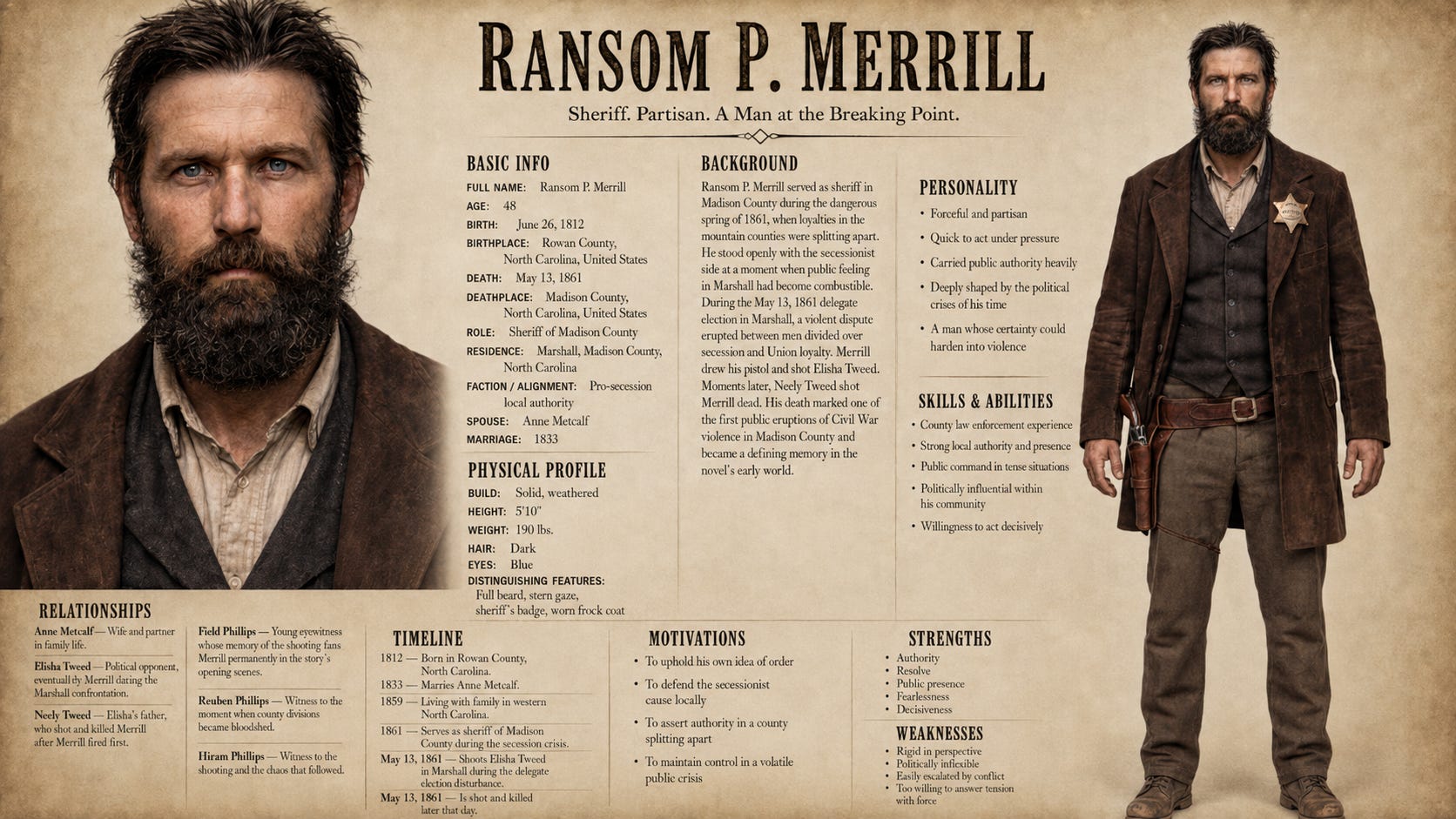
This second week belongs to Sheriff Ransom Merrill.
Sheriff Ransom Merrill
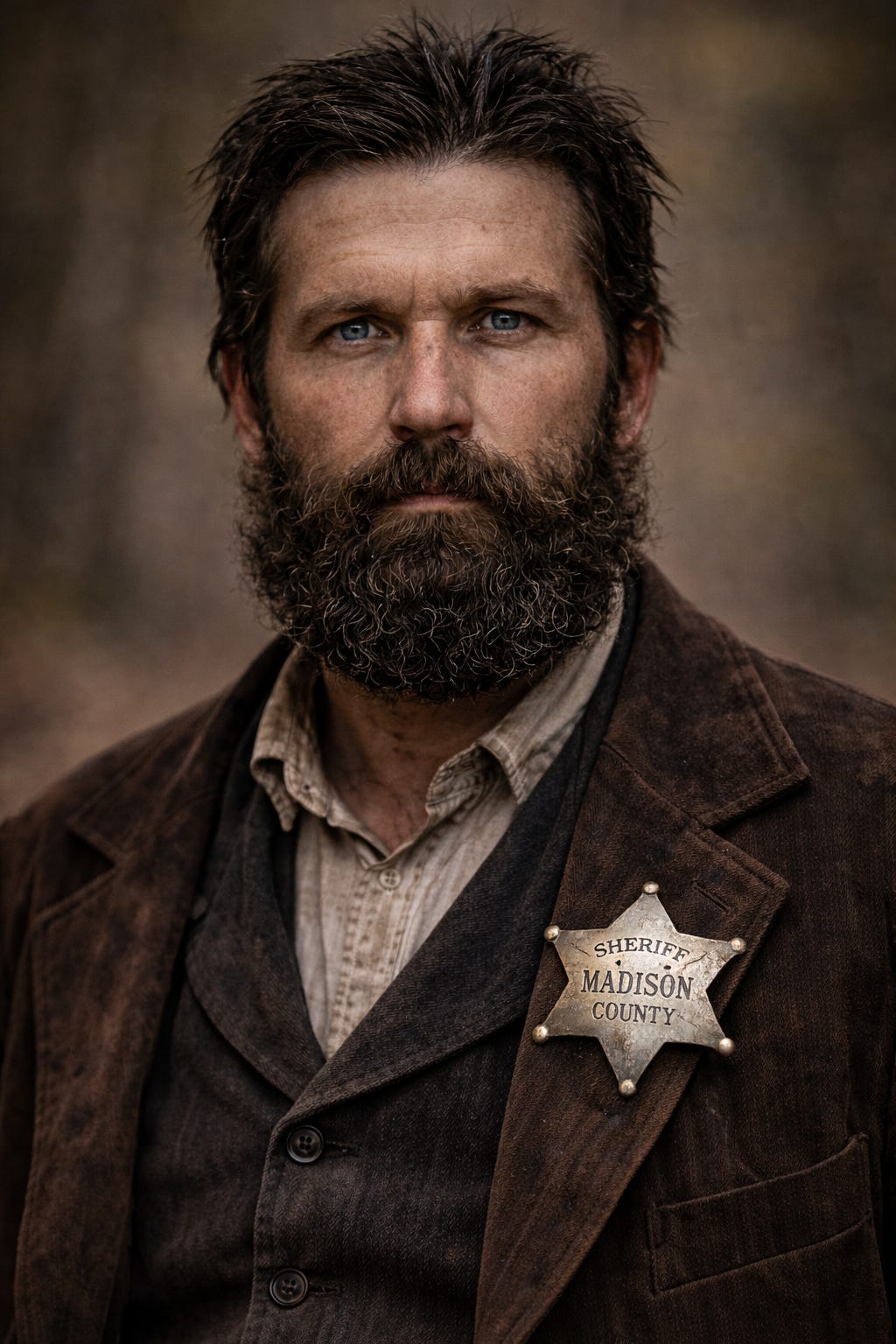
Ransom Merrill does not occupy many pages of The Blue Ridge Between Us.
He does not need to.
One decision gives him a place in nearly everything that follows.
When Fidel Phillips rides into Marshall with his father Reuben and his older brother Hiram, the county is already straining under political division. Men crowd the square. Arguments flare and disappear. Loyalties are becoming visible. Everyone seems to understand that something could happen, yet no one knows which word, shove, threat, or movement might finally make it happen.
At the center of that gathering are Ransom Merrill and Elisha Tweed.
The argument between them tightens.
Then Merrill raises his arm.
Fidel sees the pistol.
And Merrill fires.
Elisha Tweed falls.
Almost immediately, Neely Tweed answers with another shot, and Sheriff Ransom Merrill falls as well. Within moments, two men are down and the square erupts into confusion.
For Fidel, the world changes in those few seconds.
Until Marshall, war is still something being discussed. It exists in newspapers, rumors, political arguments, speeches, and the increasingly heated conversations of adults.
After Marshall, it has a sound.
A pistol shot.
Then another.
It has bodies in the street.
It has neighbors killing neighbors.
And Ransom Merrill is standing at the exact point where that transformation occurs.
Later, as Reuben, Hiram, and Fidel ride away from Marshall, Hiram asks the question that matters.
Did you see?
Reuben answers simply:
“Merrill shot him first.”
That fact matters.
It would be easy, therefore, to make Merrill nothing more than the villain of the scene. The sheriff who drew his pistol first. The man whose decision helped turn a political confrontation into bloodshed.
But The Blue Ridge Between Us asks us to look a little closer than that.
We do not get to climb inside Merrill’s mind in those final seconds.
Was he frightened?
Enraged?
Did he believe Elisha Tweed was about to act against him?
Was the pistol intended first as a threat?
Had anger already carried him beyond the point where judgment could stop him?
Fidel himself is left wondering whether Merrill intended threat before murder. The book does not give him an easy answer, because sometimes history leaves behind an action far more clearly than it leaves behind the thoughts that produced it.
What we do know is what Merrill chose to do.
He raised the pistol.
He fired first.
And Neely Tweed answered.
That does not mean all the hatred that divided Madison County began with Ransom Merrill. It was already there. The square was already crowded with anger, suspicion, political allegiance, fear, and men waiting to see what someone else would do.
But somebody eventually had to cross the distance between angry words and blood.
In The Blue Ridge Between Us, Merrill is that man.
And once the shot is fired, there is no taking it back.
The consequences spread far beyond the two men who fall in Marshall.
Fidel remembers everything.
Merrill’s arm rising.
Elisha Tweed falling.
Neely Tweed firing.
Merrill going down.
The frightened crowd.
His father’s hand gripping his shoulder.
And, almost unnoticed among the chaos, a young boy from Shelton Laurel staring back at him from a wagon.
That boy will appear again.
And again.
The consequences of that day will reach across the Civil War and long beyond it.
Marshall does not settle after the shooting.
It grows louder.
Stories of what happened travel down roads and into homes, stores, churchyards, mills, and fields. Men argue over whether Merrill was forced to draw, whether the confrontation was planned, and what the killings mean for a county already beginning to divide against itself.
That is why Ransom Merrill matters to this story.
Not because he remains with us for hundreds of pages.
Because his final act does.
He becomes one of those people in history whose importance is measured not by how long they remain in the story, but by how far the consequences of a single moment travel after they are gone.
Was Ransom Merrill a bad man?
That is not really the question I want these character spotlights to answer.
The more interesting question is this:
What happens when an ordinary man, carrying authority, anger, fear, and whatever private convictions he brought into that square, is given one terrible second in which he must decide what to do?
Ransom Merrill made his decision.
Elisha Tweed fell.
Neely Tweed answered.
And for Fidel Phillips, Madison County would never look quite the same again.
Ransom Merrill’s story in The Blue Ridge Between Us is brief.
His shadow is not.
That is Sheriff Ransom Merrill.
Thanks for reading.
Ryan E. Phillips